 Dr. Cassie McKay
Patients, they check in for registration here. A nurse eyeballs them, makes sure they're not dying. If not, they're moved to one of two triage rooms for vitals and a quick chair exam where you can order your labs and your X-rays. And then they come back to Waiting room, until a bed opens up.
MVMS3 Victoria Javadi
For how long?
McKay
Eight hours, if they're lucky. A lot of times, 12.
MDMS4 Dennis Whitaker
Uh, is it always this busy?
McKay
Uh, no. It gets a lot busier.
OWOtis Williams
Am I gonna be OK?
McKay
Yeah. You just need to take it easy on yourself. Muscle breakdown and myoglobin damaged your kidneys.
OWOtis Williams
Why'd you shock my heart?
McKay
When your kidneys don't work, potassium builds up and messes with the electrical activity in your heart.
OWOtis Williams
Can it happen again?
McKay
We gave you medicine to lower your potassium, and you'll need dialysis to clear it all out.
OWOtis Williams
Then I'll be OK?
McKay
Yeah. You might need a week or two for your kidneys to recover, but yeah. You really need to hydrate like crazy before and after a triathlon.
OWOtis Williams
Trust me, I won't let this happen again.
McKay
Good. Be kind to yourself.
Excuse me. Excuse me. I've been here for over five hours, okay, way longer than that chick. Can you check the list? Driscoll? Doug Driscoll.
E-everybody is seen as quickly as possible and in order of medical care needed.
McKay
Would you look at that, Mr. Driscoll? It's actually time to bring you back.
McKay
Would you take care of Mr. Driscoll?
SDSherry Davis
No, who's Kiara?
Oh, she's the hospital social worker. She can help you out with, like, housing and childcare - and food and security
SDSherry Davis
[to Dr. McKay] You told her?
McKay
No, I-I...
No, no, it's all free. The system works if you use it. You just have to...
McKay
Enough!
SDSherry Davis
I don't need your help. Nice speech. Next time, mind your own business.
[McKay pulls Javadi to the hall]
McKay
You ever heard of impact over intent?
I would never intentionally embarrass anybody.
McKay
But you did. You didn't have a conversation with Sherry or ask her what she needed. Instead, you walked in here and told her what to do. You gotta slow down, take a beat, and listen instead of judging people. Look, maybe I have a better perspective because I've been on both sides, but we gotta try to at least put ourselves in their shoes. Listening and building trust will make us better doctors and better people.
McKay
I'm not telling you this to reprimand you. I'm trying to teach you to help you.
Aren't board rounds at 2:00?
These aren't board rounds. I just want to remind you all of a few things, OK? So we do a great job coming up with the right diagnosis and treatment plan for our patients, but there are still some opportunities for improvement.
First off, always sit down at the bedside of a stable patient. It will make you a better doctor. Second, if there's a discharge to be done, do it before you pick up a new patient. The patients are very aware of the time that they spend with us, so please don't keep them here any longer than they need to be.
McKay
They complain about the wait.
I get it, but for the sake of efficiency and running smoothly on our end and opening up beds and opening up rooms, let's discharge before we start with somebody new, OK? Thank you. Lastly, in your medical records, make sure that your decision-making and your notes reflect not just the diagnosis but all the thought that you put into ruling out all the critical illnesses in the differential.
More work? I do enough charting as it is.
The hospital won't admit this, but it's less about charting and more about profit.
OK? Good. That's it. Goodbye. Go.
Yeah, purulent drainage from the cervix. Got the culture. Oof. Looks like we have our source. The positive urine this morning was contaminated.
McKay
Maybe.
Definitely. Not-so-clean catch specimen.
This infection's been brewing for a while.
McKay
So the car crash was a coincidence.
Not necessarily. She was probably already septic as the disease progressed, dropped her BP, and passed out while driving.
McKay
She wasn't hypotensive when she arrived.
Adrenaline rush from the car crash and the sternal fracture raised her BP but not for long.
McKay
Oh. No history of fever.
Bet she was taking Tylenol for the pain.
Let's call ICU for an admit. Also want gyn to see her.
McKay
She had mild lower abdominal pain and a positive urine dip. No fever, no back pain to indicate pyelonephritis. She was alert, walking, talking. It just seemed like a simple UTI. I saw no reason to have her wait eight hours for a bed for a pelvic exam.
McKay. Every postpartum patient needs a pelvic exam to rule out endometritis.
McKay
Wait, you're saying that with 20/20 hindsight.
Did you ask about Tylenol or ibuprofen use? Because that can mask a fever.
McKay
There was no fever.
Did you do a careful abdominal exam?
McKay
It was a quick chair exam, and there was only mild tenderness over the bladder.
Perhaps there was something about the patient that made you overlook proper treatment.
McKay
Like what, other than the obvious health risk factors?
Her size doesn't inherently make her unhealthy.
McKay
Are you saying I was biased against the patient because of her weight?
I raise it as a possibility, not as an accusation.
McKay
Wow. I mean, I really don't think that's the case here, but I will look out for it. Yeah.
McKay
Look, do I think he needed to chill out a little bit? Yes. But he's a parent, and this might be his way of coping with the stress of a very frightening situation.
I'm sorry. I don't know what came over me.
McKay
No, I do. You and that baseball kid are two pressure cooker prodigies in a pod. Just as physicians, we gotta learn to keep our emotions in check and not let our personal experiences interfere with our professional responsibilities.
How long did it take you to learn that?
McKay
I'm still learning. And I also learned to never get on your bad side.
This is how it's going to work. Our ambulance bay is now our Triage. EMS will be overwhelmed. Most will probably arrive by car, several victims per vehicle. For all you newbies that don't know, Dr. Shen is our night shift attending. John, I'm gonna put you on Point Triage.
Triage will decide who goes where depending on their injury.
Every department will have a designated primary who will oversee their staff. If you need someone, look for the vest. We're all gonna have walkies. We can get you whatever you need.
No patient goes into a room unless it's a trauma bay, and they will have four patients each. We need to keep everybody out in the open so we can keep an eye on everything, OK? Triage is gonna assess and assign every patient to a specific zone with a colored slap band. Patient who comes in with a red slap band goes to the Red Zone, which is the trauma rooms, with overflow out here. These are the most critical patients who will die without immediate attention. Samira, where are you? You are here with Dr. Abbot and me. Jack's gonna run traffic.
We have five minutes to try and stabilize the reds. After that, it's OR, ICU, or morgue.
The south and central common area over there will be the Pink Zone. That is for patients who will die in under an hour without treatment. McKay and Javadi, you are over there, with help from incoming night shift and surgical staff. Yellow Zone is the North Corridor. Those are gonna be mostly extremity wounds good vitals, talking. Mel, you're gonna run point there with Santos and Whitaker.
Uh, what if what if there's a-a pulseless extremity?
Oh, if you if you can't feel a pulse, check for Doppler flow with this. It's a mini-ultrasound. Follow the screen prompts.
But a yellow can change to a red if they go south. You got to stay on top of them, even if they seem stable.
You got this, Dr. King. Green minor lacs and sprains. They go to Family Medicine. Black and white bands are DOA, imminent death. Pedes is now our morgue. Let's hope we don't get too many of these.
We're a MASH unit now. There's no charting, no electronic medical records, no board.
McKay
How do we document treatment?
Oh, you'll all get Sharpies, and every patient has a wrist chart to document treatment and procedures. You run out of room, write on the patient's forehead.
McKay
Really?
Each wrist chart has a unique mass-casualty-incident barcode and patient number. That's how the patients are gonna get identified.
This is no-frills combat-zone medicine. No ultrasound, no X-rays, no CT, no labs. Assess based on mental status and pulse strength. Every critical patient gets an IO, intubation, a unit of blood and chest tube if needed. Everything you need blood, drugs, bandages everything will be in the Behavioral Health rooms. That's our supply depot. Um oh, keep a couple of 11 blades in your pocket. Goal is to resuscitate ASAP so they'll make it upstairs for definitive care.
Trauma surgery and neurosurgery will decide who goes up to the OR immediately and who goes to the ICU for further treatment and evaluation. Communicate. Ask for help if you need it. Trust your attendings. We will get through this together.
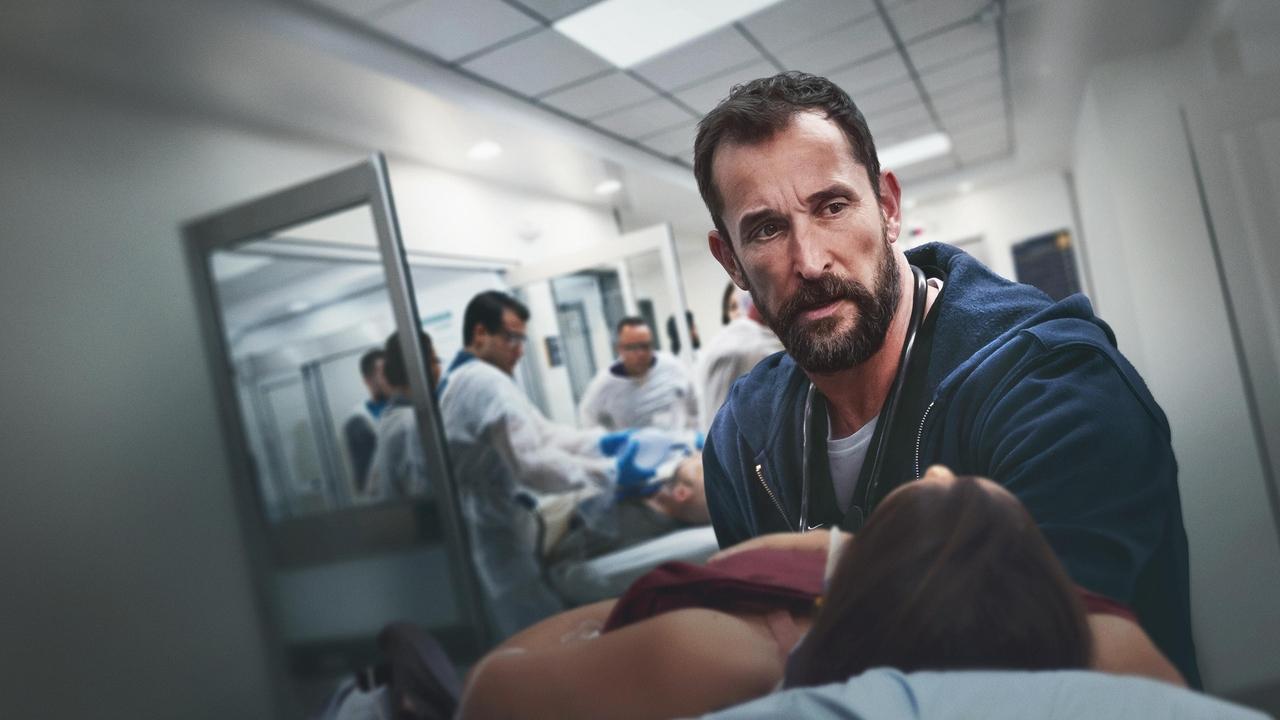
 The Pitt · 77 quotes