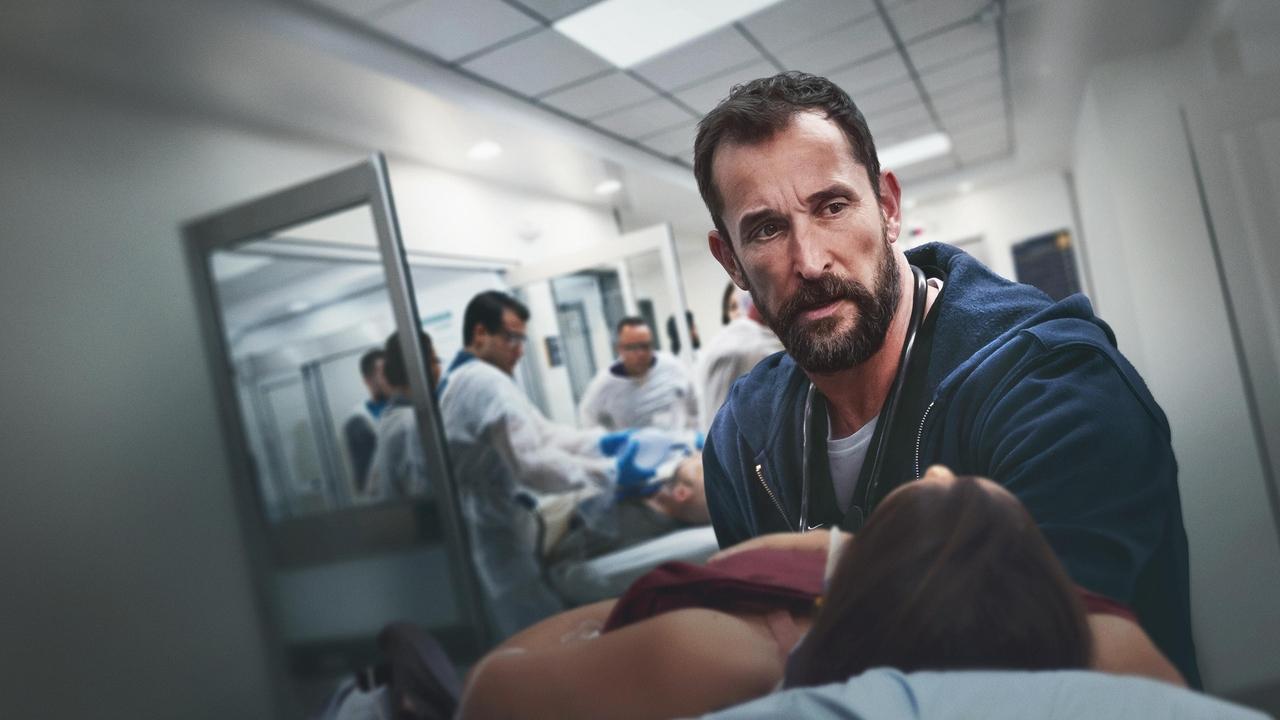


There is an active shooter at PittFest. As the nearest trauma center, we are going to be getting the majority of the victims. We don't know yet how many we are getting, but we are instituting hospital-wide emergency protocols. We need to move every patient out of here. They either go home, they go upstairs, or they go to Family Medicine. Call your loved ones now if you need to. I can guarantee you cell service will soon be overwhelmed. Eat something. Stay hydrated. Use the bathroom while there's time and meet back here for a full briefing in five minutes.
“6:00 P.M.” · Season 1, Episode 12
In this episode: Robby Robinavitch (5), Dana Evans (2), King (2), Dr. Shen (2), Dennis Whitaker (1), Dr. Cassie McKay (1), Dr. Jack Abbot (1), Gloria (1)
["Code Triage, Emergency Department now." over Public Address system]
We're locking down the hospital and setting up a command center in Administration. We'll coordinate logistics, supplies, communication.

How many casualties?
Unclear, but initial reports are not good.
OK.
The night shift is gonna be here soon, but we are gonna need more help, especially from Surgery and Anesthesiology.
MCI group text and email went out to everyone, including Transport and Environmental Services.
OK, good. [to Dana] Hey, everyone's gonna want to come in to help. Keep enough in reserve. Tell them to come in eight hours later to give us a break. And can you try and reach Jake?
Of course.
Surgery's got to call in the cavalry. We're gonna need all 25 ORs.
Ahead of you. Four ORs are prepped and staffed, and we're working on getting the rest up and running.
What about disaster supplies?
On their way.
Every patient in the ER needs to go up. Beds or no beds, they'll get better care in an upstairs hallway than ignored down here.
Agreed.

There's a whole wing that's empty on the eighth floor. I don't know if that's...
But no nurses to staff it.
No comment on that one. Waiting room and Triage can go to Family Medicine Urgent Care. And we should turn off the TVs. We don't need to cause any extra panic.
Will do.
The cafeteria will handle the family members and survivors.
What else do you need?
Prayers wouldn't hurt.
Amen to that.
Keep the press out of here.
Gladly. Call me directly if you need anything else.
OK, will do. Thank you.
This is how it's going to work. Our ambulance bay is now our Triage. EMS will be overwhelmed. Most will probably arrive by car, several victims per vehicle. For all you newbies that don't know, Dr. Shen is our night shift attending. John, I'm gonna put you on Point Triage.
Cool.
Triage will decide who goes where depending on their injury.

Every department will have a designated primary who will oversee their staff. If you need someone, look for the vest. We're all gonna have walkies. We can get you whatever you need.
No patient goes into a room unless it's a trauma bay, and they will have four patients each. We need to keep everybody out in the open so we can keep an eye on everything, OK? Triage is gonna assess and assign every patient to a specific zone with a colored slap band. Patient who comes in with a red slap band goes to the Red Zone, which is the trauma rooms, with overflow out here. These are the most critical patients who will die without immediate attention. Samira, where are you? You are here with Dr. Abbot and me. Jack's gonna run traffic.
We have five minutes to try and stabilize the reds. After that, it's OR, ICU, or morgue.
The south and central common area over there will be the Pink Zone. That is for patients who will die in under an hour without treatment. McKay and Javadi, you are over there, with help from incoming night shift and surgical staff. Yellow Zone is the North Corridor. Those are gonna be mostly extremity wounds good vitals, talking. Mel, you're gonna run point there with Santos and Whitaker.

Uh, what if what if there's a-a pulseless extremity?
Oh, if you if you can't feel a pulse, check for Doppler flow with this. It's a mini-ultrasound. Follow the screen prompts.
But a yellow can change to a red if they go south. You got to stay on top of them, even if they seem stable.
OK, yeah.
You got this, Dr. King. Green minor lacs and sprains. They go to Family Medicine. Black and white bands are DOA, imminent death. Pedes is now our morgue. Let's hope we don't get too many of these.
We're a MASH unit now. There's no charting, no electronic medical records, no board.

How do we document treatment?
Oh, you'll all get Sharpies, and every patient has a wrist chart to document treatment and procedures. You run out of room, write on the patient's forehead.
Really?
Yeah, really.
Each wrist chart has a unique mass-casualty-incident barcode and patient number. That's how the patients are gonna get identified.
This is no-frills combat-zone medicine. No ultrasound, no X-rays, no CT, no labs. Assess based on mental status and pulse strength. Every critical patient gets an IO, intubation, a unit of blood and chest tube if needed. Everything you need blood, drugs, bandages everything will be in the Behavioral Health rooms. That's our supply depot. Um oh, keep a couple of 11 blades in your pocket. Goal is to resuscitate ASAP so they'll make it upstairs for definitive care.
Trauma surgery and neurosurgery will decide who goes up to the OR immediately and who goes to the ICU for further treatment and evaluation. Communicate. Ask for help if you need it. Trust your attendings. We will get through this together.
Damn right we will.
That's a lot of wrist charts.
Let's hope we don't need them all. Were you at the last mass-casualty faculty meeting?
Oh, no. I was still a resident three months ago.
Right. Wow. Well, one patient at a time, right? The goal is to triage each patient in ten seconds.
Ten seconds, got it.
Mental status is [w:AVPU|]]. Alert, response to verbal, response to pain, unresponsive.
Yep.
Next, do they have a pulse? Radial, carotid, or femoral tells you where to send them. That's it.
OK. Cool. Oh, I heard it might rain today.
John?
Yeah, man.
Mental status and pulse gives you everything you need.
Cool.
Unresponsive with no pulses, slap a black and white band on them, send them to the morgue. Responds to pain with a faint groan, weak femoral pulse, no radial?
Uh, red.
Right. Slap a red band on them, send them back. Awake, alert with strong radial?
Trick question. Could be green, Family Medicine for scrapes or sprains, but stable, penetrating extremity wounds go to yellow.
Perfect.
Dude, relax. I got the front door. You worry about the back.
Oh, um, and four of Ancef. Sorry, I forgot the Ancef. Thank you... .
PAPerlah Alawi
Mel! Mel, I need you to reassess, please, now.
Sylvia? Oh, Sylvia. Her pulse is weak and thready. She's, uh, bleeding out from her liver lac. I need O-neg!
O-neg's gone, honey. Gloria's got more flying in. Incident Command, what's the ETA on our blood?
[Incident Command relays it would take eight to ten minutes]
The patient's gonna have to get by with a liter of saline.
No, no, she needs blood, not crystalloid. Um, can she go to surgery?
All right, she's next to go, as soon as we get an open OR.
She's not gonna last that long -- Dr. Robby. Dr. Robby! Dr. Robby, we're out of O-neg, but I'm O-neg. Can I donate?
Gloria's got more blood flying in.
But I need it now.
What is our blood status?
Just used the last units of O-neg and O-pos. More flying in.
ETA?
Less than 10.
Some patients are not gonna last that long. And I'm sure there are other O-neg donors that probably work here, so...
It would take hours to screen for HIV and hepatitis.
Well, I have neither, and I donate all the time.
[Robby sighs]
Please.
Fuck it. If the patient's gonna die before they get to the OR, then the benefits outweigh the risks.
My man. All right, kid, roll up your sleeve I'll meet you in 7. Listen up. Central 7, 8, 9 is now the blood donor center. Anyone who's O-neg or O-pos, we need you to donate now. Hands where I can see them. OK, let's do this.
These quotes come from Wikiquote's The Pitt pages and are available under the Creative Commons Attribution-ShareAlike License.