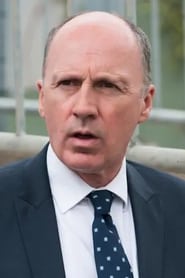
Morning, Bryan. Are you aware that we had a transport meeting this morning?

Yes, it was cancelled.
Yes, good. Thanks, I worked that out, Bryan. There’s nothing like sitting in someone’s empty office for 40 minutes to focus the mind, is there?

The Games · Season 2, Episode 3
“Reconciliation” · Season 2, Episode 3
In this episode: John Clarke (8), Gina Riley (5), Bryan Dawe (3), Nicholas Bell (1)
Morning, Bryan. Are you aware that we had a transport meeting this morning?
Yes, it was cancelled.
Yes, good. Thanks, I worked that out, Bryan. There’s nothing like sitting in someone’s empty office for 40 minutes to focus the mind, is there?
How do you spell "phonics"?
The way it sounds.
Doesn’t fit.
"Incongruous"?
[John is throwing the day's post into the bin]:
Ah, John? Any for me in there?
No, Bryan.
How do you know? You’ve just chucked it all out.
Most of it was from the public.
They’d be in that in a minute wouldn’t they, the media? Planeload of dedicated Australian journalists. A few photographers. A couple of drug and alcohol counsellors.
We were flying in the face of one of the basic rules of food consumption.
Which one?
"Never eat in a Scottish restaurant."
[On telephone] Hello. How would your radio show like exclusive coverage of one entire leg of the Olympic torch relay? No, there would be no fee involved. No. [Shouting] Because we haven’t got any money!
Much could be made in achieving this end if the government were to address the deep wrongs inflicted on the indigenous population and attempt to achieve true reconciliation with the Aboriginal peoples.
Yes. When?
I hope the Games go ahead as planned.
Yes. Pretty soon...
They’re concerned that Australia’s treatment of its Aboriginal people is... you know.
A disgrace?
Well, he didn’t actually say that.
Well, he wouldn’t. He’s a diplomat.
Have they got witchetydoodles?
Didgeridoos?
Long thing. You blow through it.
Didgeridoos, Nicholas.
Bloody marvellous. There you are, then.
I’ve got an answer.
I’m delighted to hear it, Gina. Kofi Annan can’t work it out; the international court at The Hague reckon it’s beyond their jurisdiction. I can’t tell you how pleased I am that you’ve bowled it over.
Good evening. My name is John Howard and I’m speaking to you from Sydney, Australia, host-city of the year 2000 Olympic Games. At this important time and in an atmosphere of international goodwill and national pride, we here in Australia, all of us, would like to make a statement before all nations. Australia, like many countries in the New World, is intensely proud of what it has achieved in the past 200 years. We have a vibrant and resourceful people. We share a freedom born in the abundance of nature, the richness of the earth, the bounty of the sea. We are the world’s biggest island. We have the world’s longest coastline. We have more animal species than any other country. Two-thirds of the world’s birds species are native to Australia. We are one of the few countries on earth with our own sky. We are a fabric woven of many colours and it’s this that gives us our strength. However, these achievements have come at great cost. We have been here for 200 years, but before that there was a people living here. For over 40,000 years they lived in perfect balance with the land. There were many Aboriginal nations, just as there were many Indian nations in North America and across Canada, as there were many Maori tribes in New Zealand, and Incan and Mayan peoples in South America. These indigenous Australians lived in areas as different from one another as Scotland is from Ethiopia. They lived in an area the size of Western Europe. They didn’t even share a common language. Yet, they had their own laws, their own beliefs, their own ways of understanding. We destroyed this world. We often didn’t mean to do it. Our forebears, fighting to establish themselves in what they saw as a harsh environment, were creating a national economy. But the Aboriginal world was decimated. A pattern of disease and dispossession was established. Alcohol was introduced. Social and racial differences were allowed to become fault-lines. Aboriginal families were broken up. Sadly, Aboriginal health and education are responsibilities we have yet to address successfully. I speak for all Australians in expressing a profound sorrow to the Aboriginal people. I am sorry. We are sorry. Let the world know and understand that it is with this sorrow, that we as a nation will grow and seek a better, a fairer and a wiser future. Thank you.
These quotes come from Wikiquote's The Games pages and are available under the Creative Commons Attribution-ShareAlike License.