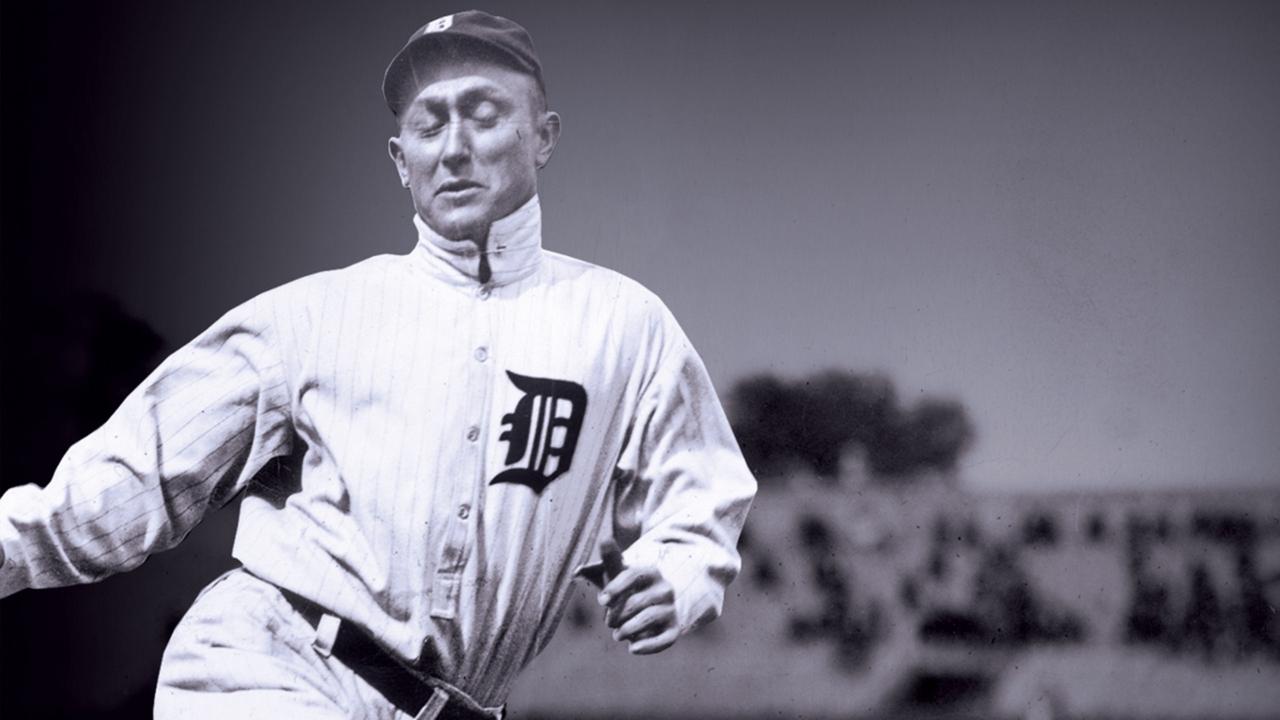
Before Ruth, pitchers were taught to pace themselves, only bearing down when someone was on base. Now, there was a danger of a run being scored at any moment. They had to bear down from the first pitch to the last. Between 1910 and 1920, 8 different pitchers won 30 or more games in a season. In the seventy-odd years since the advent of Babe Ruth, there have been just three.

All S1
S1 E15Unfinished Business
If you play against the best clubs in the land–white clubs, as you say–it'll be a case of Greek meeting Greek. I fear nobody.
I got a letter the other day asking why I didn't write about baseball no more, as I used to write about nothing else, you might say. Well, friends, I may as well admit that I have kind of lost interest in the old game. A couple of years ago, a ballplayer named Babe Ruth that was a pitcher by birth was made into an outfielder, on account of how he can bust them. And the masterminds that control baseball says to themselves, "that if it is home runs that the public wants to see, why, leave us, give them home runs."
The Yankees were on their way to a fourth consecutive pennant in 1924, when they were stopped cold by one man: Walter Johnson.
When we got to the ballpark, we knew we were going to win. That's all there was to it. We weren't cocky. I wouldn't call it confidence, either. We just knew. Like when you go to sleep, you knew the sun's going to come up in the morning.
The idea of community, the idea of coming together—we’re still not good at that in this country…In moments of crisis, we’re magnificent at it—the Depression, Franklin Roosevelt lifting himself from his wheelchair to lift this nation from its knees. At those moments, we understand community—helping one another. In baseball, you do that all the time. You can’t win it alone. You can be the best pitcher in baseball, but somebody has to get you a run to win the game. It is a community activity. You need all nine people helping one another. I love bunt plays. I love the idea of the bunt. I love the idea of the sacrifice. Even the word is good. Giving yourself up for the good of the whole. That’s Jeremiah. That’s thousands of years of wisdom. You find your own good in the good of the whole. You find your own individual fulfilment in the success of the community—the Bible tried to do that and it didn’t teach you. Baseball did.
He died two years later, mourned by many as the greatest of all baseball managers, the winner of 10 pennants. Not long after his death, his wife found among his effects a list of all the Black players he had secretly wished he could hire over the decades.
The Depression was the worst crisis in America since the Civil War. In Harlan County, Kentucky, where the coal industry had died, whole communities tried to survive on dandelions, and blackberries, and pokeweed. Farm prices collapsed, and farm families were driven off the land. In just one day, one quarter of the entire state of Mississippi went under the auctioneer’s hammer. Banks failed, and in several bankrupt cities, the animals in the zoo were shot and the meat distributed to the poor. Hundreds of boys and men thumbed their way to Florida to try out for the big leagues, hoping not for stardom but simply for a job. Half-starved and in rags, without money, gloves or shoes, most were turned away. Some who did get a tryout collapsed on the field from exhaustion and hunger.
How to stay young:
There's a catcher that any big-league club would like to buy for $200,000. His name is Gibson. He can do everything. He hits the ball a mile, and he catches so easy, he might as well be in a rocking chair. Throws like a rifle. Too bad this Gibson is a colored fellow.
By 1934, the world economy was in ruins, and fascism was on the rise. In Germany, the National Socialists had come to power and [had] begun to institute exclusionary laws against Jews, in an eerie echo of Jim Crow statutes in the United States.
From then on, until the day he died, Claire Ruth remembered, Ruth sat by the telephone, waiting for a call to manage that never came.
That winter, Chester Washington of the Pittsburgh Courier sent a telegram to the manager of the struggling Pittsburgh Pirates. 'To: Pie Traynor, Pittsburgh Pirates, Congress Hotel. Know your club needs players. Have an answer to your prayers right here in Pittsburgh. Josh Gibson, catcher. Buck Leonard, first base. S. Page, pitcher and Cool Papa Bell all available at reasonable figures. Would make Pirates formidable pennant contender. What is your attitude? Wire answer, Chester Washington.' There was no answer.
But for black baseball players in America, nothing had changed. For most, the season didn't end in October. When the weather turned cold, they headed south to Latin America, Cuba, and Mexico, where they found a warm welcome playing wintertime baseball. "Not only do I get more money playing here," shortstop Willie Wells wrote after leaving the Newark Eagles for the Mexican league, "but I live like a king. I've found freedom and democracy here, something I never found in the United States. Here in Mexico, I am a man."
On May 1, 1939, something that had not happened for 14 years, happened to the Yankees: Lou Gehrig took himself out of the lineup. He had played in a record 2,130 consecutive games and earned himself the nickname "The Iron Horse." But now, something was terribly wrong. He was only 35, but had begun to play like an old man: dropping balls, missing again and again at bat, sliding his feet along rather than lifting them. During batting practice one afternoon, Joe DiMaggio watched in astonishment as the Yankees' hitting star missed 10 fat pitches in a row. Gehrig could not understand what was wrong; neither could his teammates. But he could not stand the thought of letting them down. He was benching himself, he said, "for the good of the team."
These quotes come from Wikiquote's Baseball pages and are available under the Creative Commons Attribution-ShareAlike License.