
Imagine you could travel back in time, to a time long before man. Back across 65 million years. As you travel, you would see huge changes in the vegetation and the climate. Even the surface of the Earth itself would move, as mountain ranges are pushed up by colliding continents. Now you've reached a remarkable period in Earth's history known as the Cretaceous. It is a very different world. The Himalayas do not yet exist, and the Atlantic is only half as wide. There is no grass, only conifer forests and fern prairies. This is a world ruled by dinosaurs. Giant reptiles like Tyrannosaurus, a five-tonne predator, stalk the landscape. In Walking With Dinosaurs, we will show you how these magnificent creatures live. How they eat, fight and reproduce. And you will witness how the forces of nature conspire to drive these animals to extinction.
Narrator
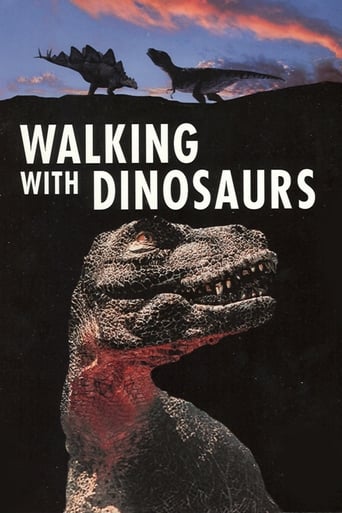 Walking with Dinosaurs · 39 quotes
Most-quoted character in Walking with Dinosaurs: in 39 of its 39 quotes
Lines by Narrator 39
First light across the western hills of Earth's only continent, Pangaea. This world has been ruled by one group of giant reptiles for over 50 million years. But these ancient creatures have had their day. All over these lush fern prairies, a grim evolutionary battle has broken out among the newer types of reptile, for supremacy of this strange world. On these Triassic proving grounds, dinosaurs are still comparatively rare. But they are beginning to show the first signs of their future success.
[about the mammal-like reptiles] One day in the future, this strategy of investing in their young will pay off for their mammalian descendants. But as mammals evolve over the next 160 million years, they will only survive as a few small species, clinging on at the edge of a world dominated by dinosaurs.
20 million years later, a massive extinction wiped out thousands of species of reptile. But the dinosaurs went from strength to strength. Carnivores grew to enormous sizes, but their prey got even bigger. In the next program, we meet the giants of the Jurassic.
This is the Jurassic period, and the giant continent of Pangea that use to stretch from pole to pole is now breaking up. It is much wetter than the earlier Triassic period, and where there were once deserts, there are now vast forests of conifer trees.
There are vast open fern prairies, and this is were the titans of the Jurassic roam. Dinosaurs like Stegosaurus, with its distinctive row of spinal plates. These prairies are kept clear of trees by the constant grazing of such giant herbivorous. And none have a larger impact on this environment than the biggest dinosaurs of them all, the sauropods. There are many different types of these gigantic, long-necked creatures. These are Diplodocus, the longest of them all.
[about the Allosaurus] These are the lions of the Jurassic. The top predators of their age.
This is Brachiosaurus, a 13 meter high sauropod that specialises in grazing on the tree tops. His kind can effortlessly harvest cones and fresh leaves no other dinosaur can reach, and they have grown enormous on it. These adults weigh 70 tons, making them the largest animals that have ever existed.
Sauropods dominate the late Jurassic, and it will be millions of years before new dinosaur herbivores evolve to replace them. With their passing, life will never again be this large.
Eventually the mighty sauropods went into decline, and their lowland prairies became flooded, because the sea levels began to rise. This created vast inland seas, and in the next program, we will meet the giant carnivorous reptiles that patrolled them.
[A Eustreptospondylus is shown on a shore]
The most fearsome predator of the Jurassic is watching his prey. Peering through the water, the carnivore fixes on his unwary victim, waiting for the perfect moment to strike.
[The massive jaws of a Liopleurodon emerge behind the dinosaur, clamping onto its tail and dragging it, screaming, into the sea]
Under these azure waters lies the future continent of Europe. But now, in the Late Jurassic period, all that exists here are a few scattered islands. The breakup of the old continents has broken up the ocean floor and raised sea levels, flooding the lowlands and creating vast shallow seas. Here, dinosaurs do not rule. Instead, giant marine reptiles have evolved, perfectly adapted to life in these beautiful waters.
These rich sunlit waters are on the northern end of the ancient Tethys Ocean, the sea that separates the Earth's two continents: one in the north and one in the south. Once a year, they are the stage for a remarkable natural drama.
The newborn pups have just a few seconds to reach the surface and take their first breath. From the moment they are born, the little pups are vulnerable. These waters are full of predators. Even adult Ophthalmosaurus will eat the offspring of others to increase the chance of survival of their own pups. The only real safety is among the crags of coral.
Liopleurodon. At 150 tons, it is the largest and most powerful carnivore ever to live on the planet. This male weighs a colossal 25 meters, and is big even for his kind. His size means he is probably over a hundred years old. Liopleurodon has a directional sense of smell, two separate chambers in his nose work in the same way as a pair of ears, pinpointing where a smell is coming from. A sophisticated tracking device, steering the largest carnivorous jaws ever known.
These quotes come from Wikiquote's Walking with Dinosaurs pages and are available under the Creative Commons Attribution-ShareAlike License.