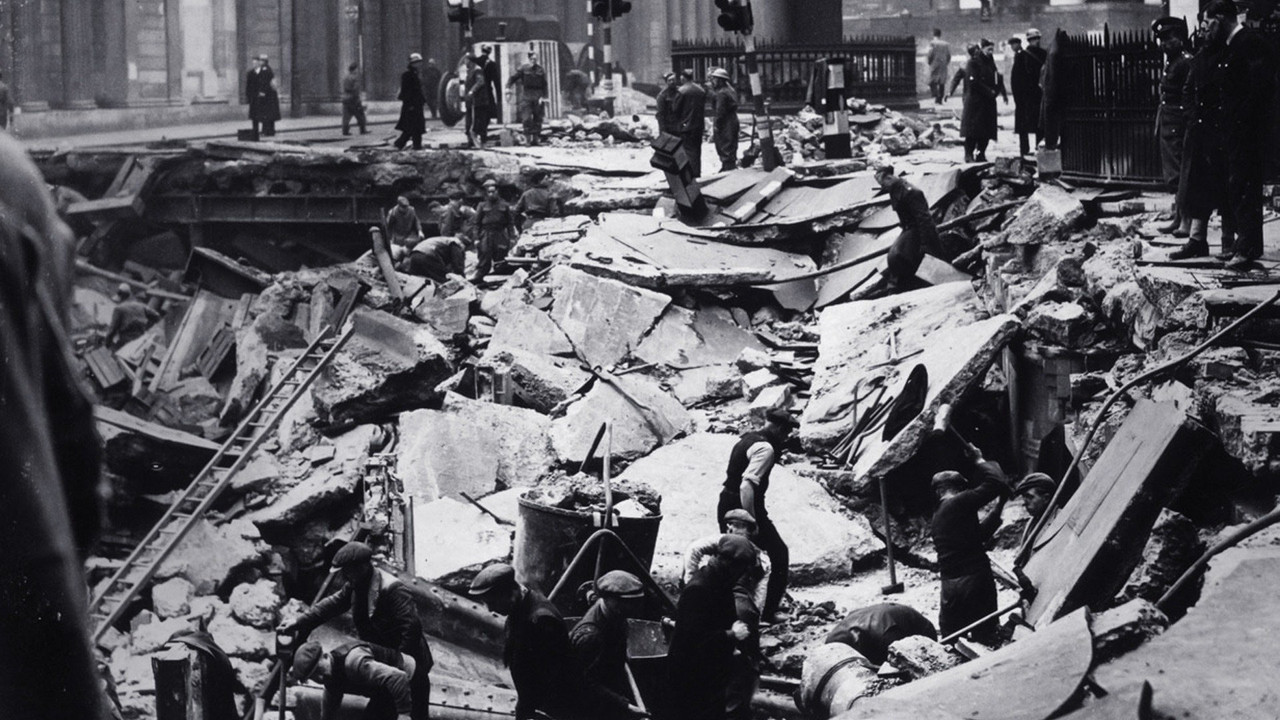
Narrator The peculiar conditions of the desert bred a comradeship which was unique in the whole war. To many, the desert war was a private war, the last to retain any pretense of chivalry.
The Desert: War in North Africa
Winston Churchill "Now, this is not the end! It is not even the beginning of the end. But what it is, perhaps, is the end of the beginning."
Stalingrad
Narrator Russia, the summer of 1942, the Germans are on the move, again. The sixth army, Hitler's largest, victorious in France, almost victorious in the first year of the Russian campaign. Now it has a new task: to fight further east than the Wehrmacht has ever fought before. To cut Russia in two, on the Volga.
Narrator Goring, the Luftwaffe's Commander in Chief. Earlier that year, his planes had supplied a whole army cut off for sixty days with fuel, ammunition and food. Now he thought they could do it again. Provided the weather was good and provided the distances weren't too great, they could fly in five hundred tons a day. Hitler thought that would do. Although he knew, the Army said, it needed at least eight hundred tons. The Russians were waiting. Bombers were used as transport. The weather was vile. The airlift was only able to bring in a tenth of what was needed. Although it did once deliver a plane load of ground pepper, and twelve cases of contraceptives.
Narrator Two German Armies, twenty Four Generals, two thousand officers, ninety thousand soldiers: prisoners. One hundred and fifty thousand dead. The Romanian, Hungarian and Italian armies destroyed. Enough materiel lost to equip a quarter of the whole German army. This was the same Sixth Army, which two years before, could not imagine defeat
Narrator When it was all over, a Russian soldier said: "Germans are funny fellows, coming to conquer Stalingrad in shiny leather boots. They thought it would be a joyride."
Narrator When it was all over, Hitler said: "What is life? Life is the Nation. The individual must die anyway. Beyond the life of the individual is the Nation."
Narrator On February the third, 1943, German radio announced that Stalingrad had fallen. That the Sixth Army had fought courageously, but had succumbed to "vastly superior enemy forces", and to "unfavorable circumstances."
Red Star
Narrator No country, no people, suffered so terribly in the war, as the Soviet Union. Nowhere else are the memories of war so alive today, and so profound. The German invasion brought about a catastrophe which seemed at first no nation could survive. In the siege of Leningrad alone, which lasted for over two years, more human beings died than the total war dead of Britain and the United States, combined. Yet it was here that Hitler was broken. The Russian people faced the possibility that they might perish, and overcame it.
Narrator In bleak places, lacking food or sleep, the Russians reconstructed a new war industry beyond the reach of the Nazis.
Narrator (describing conditions in Leningrad) Bread was now made with sweepings, cattle cake, sawdust. People ate soap, linseed oil, the paste for wallpaper.
One can bear anything -the plague, hunger and death -but one cannot bear the Germans. One cannot bear these fish-eyed oafs contemptuously snorting at everything Russian. We cannot live as long as these grey-green slugs are alive. Today there are no books, today there are no stars in the sky. Today there is only one thought -kill the Germans. Kill them all and dig them into the earth. Then we can go to sleep.
Whirlwind: Bombing Germany
HMHamish Mahaddie
If you couldn't get the kraut in his factory, it was just as easy to knock him off in his bed, and [if] granny Schicklgruber in the seat next door got the chop, that's hard luck.
Fighter Command had shown how difficult it was for bombers to destroy a country which could defend its own airspace – a lesson the Air Staff apparently neglected to teach itself.
Tough Old Gut
Narrator Winston Churchill once told Stalin, the Mediterranean is the soft underbelly of the crocodile. Churchill and the British chiefs of staff were sure that attacking German occupied Europe through Italy would help shorten the war. The Americans were not convinced, preferring to concentrate on the decisive blow across the English Channel. Only reluctantly did they agree to join their British allies on the road to Rome.
These quotes come from Wikiquote's The World at War pages and are available under the Creative Commons Attribution-ShareAlike License.