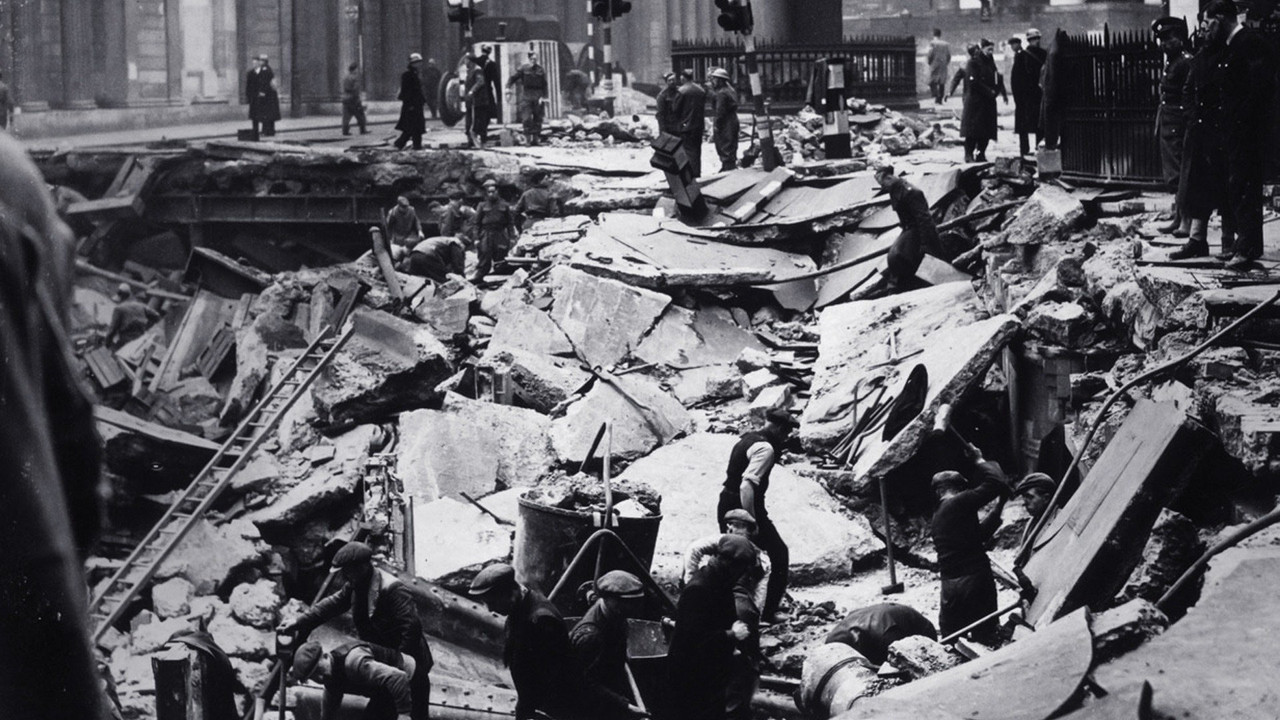
Let us pray that peace be now restored to the world and that God will preserve it always.
Episode Twenty Four: The Bomb
North Field on the Island of Tinian, in the Marianas - 1,500 miles south of Japan. Here on August the fifth, the world's first Uranium bomb was loaded into a B-29 Bomber, named Enola Gay - after its pilot's mother. The next day before dawn, the Enola Gay took off. It's target: Hiroshima.
Narrator On April the 12th 1945, Franklin Roosevelt, President of the United States, died suddenly. The nation mourned its lost leader. He had brought them from the depths of economic depression 12 years before, now he had led them to the eve of victory in a World War.
Kishi Matsukawa (describing her experiences of the atomic bombing of Hiroshima): When I regained consciousness everything was pitch dark all around me. I tried to stand up, but my leg was broken. I tried to speak and I found that six of my teeth had been broken. Then I realised that my face was burnt and my back was burnt. There was a slash right across from one shoulder down to the waist. I crawled to the riverbank and when I got there I saw hundreds of bodies come floating down the river. And it was then that I realised with a shock that all Hiroshima had been hit.
Kiyoshi Tanimoto (describing his memories of the atomic bombing of Hiroshima): I encounter a long and ceaseless line of escapees. All of them had no clothes whatsoever on their bodies. And the skin from their faces, arms and breast peeling off and hanging loose - and yet without any expression. In deep silence they are escaping. I thought it was a procession of ghosts.
Episode Twenty Six: Remember
NFNoble Frankland
The effect of war on people who take part in it is, of course, extremely various. Lots of people are maimed, completely either mentally or physically. But I suppose the majority of those who survive, survive apparently intact. But there must be marked effects, and in some ways the effects are very good on people, because they feel that they’ve been able to fulfil themselves. A lot of people go through life without ever feeling a sense of fulfilment, but those who take part in hectic war operations usually get a sense of fulfilment, to some extent, especially if they believe in what they’re trying to do, which I think in war people tend to do very readily. On the other hand, I think that there are very bad effects, obvious bad effects. Perhaps one of the less obvious ones is that people undertake these operations I think have a tendency to feel afterwards that society owes them something very special. And when the war is over, they tend to go home or back to where they came from and expect people to look up to them and to look after them, which is not what people are going to do at all, nor is it even what people ought to do.
(last lines) At the village of Oradour-sur-Glane, the day the soldiers came, they killed more than six hundred men, women ... and children. Remember.
A New Germany
(opening lines) Down this road on a summer day in 1944, the soldiers came. Nobody lives here now. They stayed only a few hours. When they had gone, a community, which had lived for a thousand years, was dead. This is Oradour-sur-Glane, in France. The day the soldiers came, the people were gathered together. The men were taken to garages and barns, the women and children were led down this road, and they were driven into this church. Here, they heard the firing as their men were shot. Then they were killed too. A few weeks later, many of those who had done the killing were themselves dead, in battle. They never rebuilt Oradour. Its ruins are a memorial. Its martyrdom stands for thousands upon thousands of other martyrdoms in Poland, in Russia, in Burma, China, in a world at war.
France Falls
Forlorn monsters today. In May 1940, these forts of the Maginot line were France's first-line defence against the Germans. Half a million French soldiers lurked beneath these man-made hills. These were the most extensive, the most elaborate forts ever constructed. Here the guns would halt the Hun - provided the Hun came this way.
Narrator "Thank God for the French Army", said Winston Churchill when Hitler came to power. But by 1940 the French army was no longer the superlative weapon it once had been. They had pioneered motor transport in warfare, but went back now to relying on railways and the horse; especially the horse.
Banzai!
Ken Murray (describing the attack on Pearl Harbor): My first knowledge of the attack was when I was awakened by the sound of bombs dropping and the roaring of aircraft all around us. I ran out and saw immediately that they were Japanese planes and there was this fellow standing next to me who said, "Boy, it certainly looks real doesn't it?" And I said, "Yes, I'm afraid it is."
On Our Way: U.S.A
Narrator February 1942, six-hundred ships loaded with men and materiel set sail for North Africa: Operation Torch. Said Roosevelt when he heard the news, "at last we're on our way."
The Desert: War in North Africa
Narrator (describing the setting of the Western desert campaign):
This land was made for war. As glass resists the bite of vitriol, so this hard and calcined earth rejects the battle's hot, corrosive impact. Here is no nubile, girlish land; no green and virginal countryside for war to violate. This land is hard. Inviolable.
Narrator February 1941, Hitler comes to Mussolini's rescue. A small mobile force that had been hurriedly put together set sail to Tripoli. A force that was soon to become known as the Afrika Korps.
Narrator The man Hitler chose to save Mussolini from further disaster had made a name for himself in France the summer before: Erwin Rommel.
These quotes come from Wikiquote's The World at War pages and are available under the Creative Commons Attribution-ShareAlike License.