TV QuotesDatabase
1 SEASON

TV show quotes

Walking with Beasts quotes

42 quotes · 1 characters · page 1 of 3

Walking with Beasts
All S1

Characters

S1 E15Unfinished Business

The last dinosaurs were already living on a sick planet, when their nemesis arrived - from space. A meteor ten kilometres wide slammed into Earth to mark the end of the reign of dinosaurs.

[The footage of storms, then a clear dark sky view]

This series is about what happened next.

The dinosaurs might be long gone, but the left the world a vicious legacy. Their direct descendants are the birds. For the first and only time in its history, birds rule the Earth.

At this time in Europe's history, Germany is at the center of much volcanic activity, and this whole forest is riddled with geothermal springs.

Although his ancestors hunted on land, Ambulocetus has evolved to be far more at home in the water. In fact, his descendants will take this to a greater extreme: you are looking at the very earliest form of whale. Ambulocetus in fact means "walking whale".

[as Gastornis kills and feasts on a Propalaeotherium] This is a world where birds eat horses!

Once more, the Ambulocetus is lying in her path - but she instinctively knows he is dead. Today the Leptictidium is the survivor, but ironically, the future holds a different outcome for these mammals. The Leptictidium and her kind are destined to become extinct when this hot wet world gets cooler and drier, and the world's forests start to disappear. Ambulocetus is the one with the big future. He is the ancestor of the whales, the most magnificent dynasty of mammals. And mammals are about to take over the world!

When the dinosaurs disappeared, so too did the gigantic marine reptiles which once terrorized the oceans. For almost 25 million years, there was nothing around to eat the sharks. But there are now awesome new monsters of the deep.

It is the late Eocene, and the world is still a hot one. However it is drier than before, and so where once the land was completely covered in lush rain forest, there are now more open spaces. Freed from the constraints of living in dense forests, some mammals have started to get larger. Here on the scrub plains, big is beautiful.

Like dinosaurs before them, mammals dominate the planet. But they are about to undergo their severest challenge. The climate change the world has seen so far is mild compared to what is coming.

[about Basilosaurus] Four times the length of a great white shark, this female weighs sixty tons. Incredible to think, then, that their ancestors were tiny, furry, shrew-like animals that lived in trees!

For the first time in hundreds of millions of years, the sea is freezing at the Poles, throwing ocean currents into turmoil. For a whale that needs on average eighty kilograms of food a day, the slightest change in fish stocks is bad news. She is at the top of a food chain that is about to collapse, and she has just become pregnant.

Against the odds, she and her calf have survived. Sadly, what the have been through is merely the start of the climate chaos to follow, which will end the Eocene period and cause the largest extinction since the death of the dinosaurs. As devastating as any meteor will be the catastrophic disruption of the oceans' currents caused by the gradual freezing of Antarctica. Like a giant El Nino, only much, much worse. 20% of living things on earth will die out. Whales as a group will survive, but Basilosaurus and her kind will not be among them.

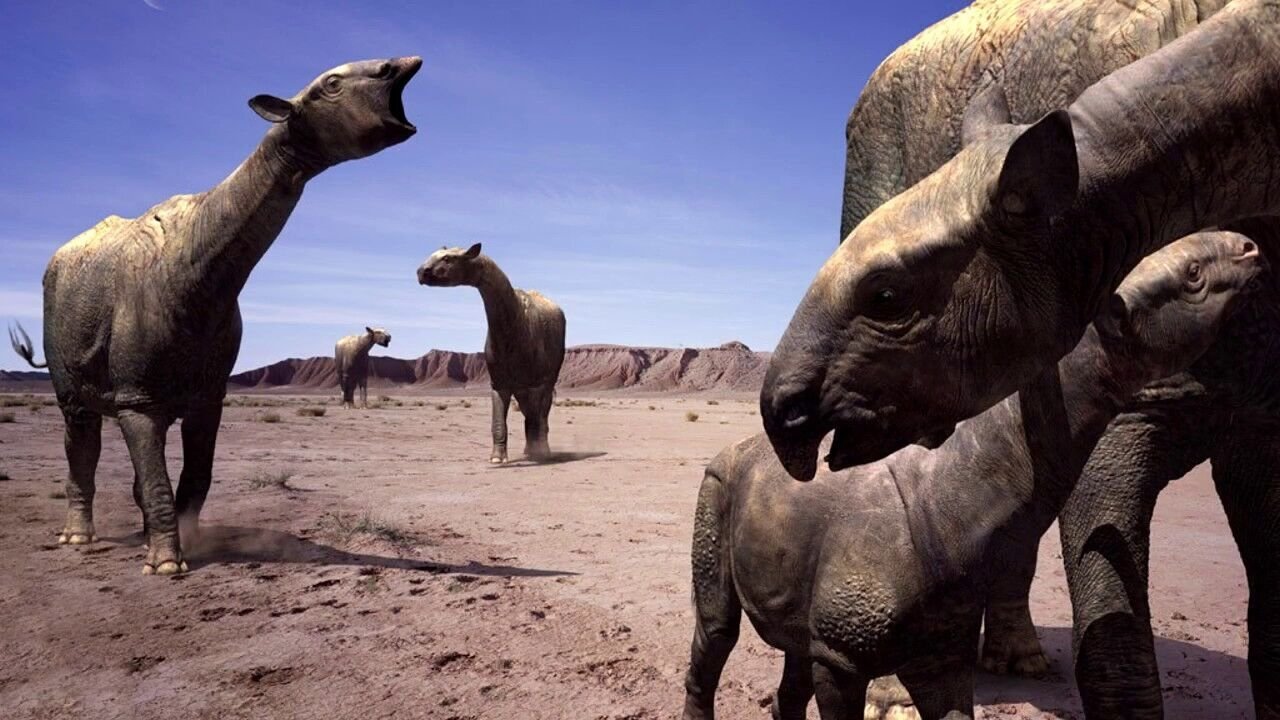
Out of the darkness emerges a twelve ton giant. She is an Indricothere, and she is about to give birth.

It is a time called the Oligocene. The world has just been through years of catastrophic climate change, that led to the extinction of one species in five. Earth has since bounced back, but in the process it's become a changed world - different weather, different plants and different animals.

Around him, the other residents of the canyon are starting to stir - strange beasts like the Chalicotheres. Almost three metres tall, they walk on their knuckles to protect their long claws. These powerful limbs are very effective defensive weapons, but more often, these herbivores use them to hook down branches to get at the softest leaves. They walk like gorillas and eat like pandas, but their closest modern relatives are actually horses!

These quotes come from Wikiquote's Walking with Beasts pages and are available under the Creative Commons Attribution-ShareAlike License.