[voiceover] Nowadays, the US government can listen to anything you say. They know where you are, they know who you're talking to, and trust me, they know who you're fucking. You turn on a cell phone or a computer, and you're doomed. But in Colombia in 1989, it wasn't that easy. First off, there was no Internet. No cells. The best they had were satellite phones, and in order to capture a satellite phone, you had to fly directly over it. On top of that, the only people who had sat phones were the filthy rich, the landowners, the politicians. And lucky for us, the narcos were richer than them all.
[as narrator] Take Richard Nixon, for instance. People forget, but 47 million Americans voted for Nixon. We thought he was one of the good guys. And Nixon thought Chilean General Pinochet was a good guy because he hated the commies. So we helped Pinochet seize power. The Pinochet turned around and killed thousands of people. Maybe not such a good guy after all.
[voiceover] Back then, we were just finding out about the effects of cocaine - on the human brain. We didn't know much, but we knew it was some pretty powerful shit. Cocaine hijacks the pleasure centers in the brain. A rat will choose cocaine over food and water. It would choose cocaine over sleep, over sex over life itself. The human brain isn't quite the same as a rodent's unless we're talking about cocaine.
[voiceover] If there's one thing I've learned in the narco world, it's that life is more complicated than you think. Good and bad they're relative concepts. In the world of drug dealers, you do what you think is right - and hope for the best.
[voiceover] By the time I left Miami, Americans were doing a couple hundred tons of cocaine every year. To satisfy American noses, the narcos ramped up their operations...They were flying so many planes, they needed a refueling stop between Colombia and Miami. So Carlos Lehder bought an island in the Bahamas as a transshipment point for the drugs and money. Turns out it was a damn good place to party. It was modern day Sodom and Gomorrah, with the three things Carlos liked most: - sex, drugs, and Nazi sympathizers.
[voiceover] One of the sicarios caught after Lara Bonilla's assassination confessed that Pablo had put out the hit. An important politician had been murdered and everyone knew who did it. Finally, the Colombian government had to react. Pablo Escobar was indicted for the murder of Rodrigo Lara Bonilla. Colombia agreed to the one thing narcos feared most: extradition. Now any Colombian who smuggled drugs to America could be prosecuted and jailed in the US, even if they never stepped foot on our soil. This made all the difference in the world. If you were a narco in Colombia, jail time meant banging girls, watching movies, hanging with the fellas. Grease the right hands and you'd get a reduced sentence for good behavior. It was a fucking joke. Back home, it was a whole different deal. The seventh richest man in the world? No one gives a shit. You still get a 6x8 cell 23 hours a day, just like every other loser, a fucking nightmare. Now Pablo had someone to fear: us.
[voiceover] While Pablo left a trail of bodies and chaos in his wake, Cali made problems disappear with an army of lawyers and a mountain of legal briefs. The Medellín cartel was Miami: swimming pools, bikini girls tacky as a two-tone Cadillac. The Cali cartel was New York: elegant, smooth, subtle. Where they could fuel the 24-hour nightlife with cocaine, and still make sure everybody showed up for work on Wall Street the next morning. At first, Medellín and Cali worked side by side. But in Colombia, when money's involved, blood inevitably flows.
[voiceover] You wanna tell me a good guy wouldn't have pushed the buttons on these motherfuckers? You wanna call me a bad guy? Fine. But if you do, it just means that you haven't met enough bad guys yet to know the difference. There's one thing I've learned down here in Colombia - good and bad are relative concepts.
[voiceover] Escobar's prison was called La Catedral, but we nicknamed it "Club Medellín." It was the embodiment of "the big lie." It was even built to look old and shitty on the outside. But inside, it was anything but. The other inmates? Escobar's sicarios. Hand-picked killers from his hometown...By the terms of his deal, no cops or military were allowed within two miles of the prison. As much as I fucking hated this guy, I had to hand it to him he had a pretty sweet deal...Escobar hadn't built himself a prison at all. He'd built himself a fortress. But no matter how you decorate it, a cage is still a cage.
[voiceover] Success. Sure, it cost me a suspension, but who cares? I just call it a week's paternity leave. I was ready to crack a beer and watch Escobar's endgame on TV. See, because of me and Peña, the Colombian government was sending in the army. Not the cops, but the fucking army. There was no way that Escobar was getting out of this one. But, then again, in Colombia nothing goes down the way you think it will.
[voiceover] Less than an hour after Escobar escaped La Catedral, word had spread all over Colombia that war was coming again. But this time would be different. This time, there would be no surrender, no negotiations, no deals. This time we were gonna kill him. Escobar said, "Better a grave in Colombia than a cell in the US." Well, guess what, motherfucker? That works for me.
[narrating] Okay, here we go again. [military siege on the prison] Let me break it down for you: 4,000 soldiers, a 250-man team of Colombia's elite forces, tens of thousands of rounds fired, seven dogs, and four fuckin' helicopters. Pablo Escobar was surrounded in the middle of fuckin' nowhere. There was no way he was getting out of this one - right?
[narrating] You know, in all the years I chased Escobar, I could count on one hand the times we almost had him. And each time, we forgot the two most important things we already knew about him: Close doesn't count, and Pablo is never more dangerous than when you almost have him. With all the cops on the street it was easy to forget this was still Escobar's town. He tolerated it all in the interest of negotiations. Chasing a man and his family out of their home in the middle of the night? That wasn't a negotiation. To Escobar, well, that was an act of war.
[narrating] Pablo Escobar said, "Sometimes I'm God. If I say a man dies, he dies the same day."In his career, this asshole killed thousands of police officers at a rate of over 400 a year. With numbers like that staring you in the face, you have to ask, what possesses a man to put on a uniform that all but guarantees his days are numbered? Most of them were just kids, raised to reach a fork in the road and choose the right path. Fight for the good guys. They were young, they were full of hope, and they thought they were invincible. And those that were left behind would feel their loss the most.

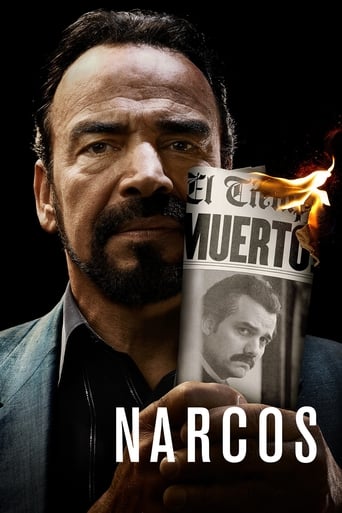 Narcos · 112 quotes
 Steve Murphy