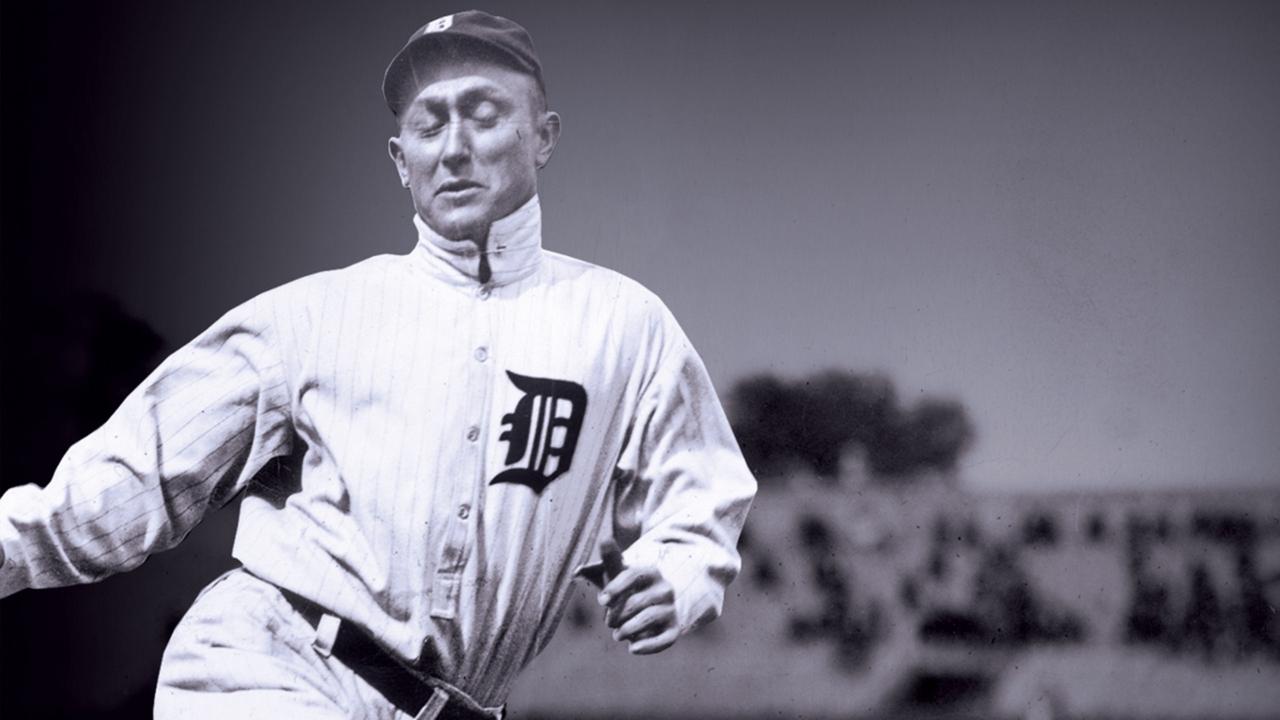
Things happened to me, all through the three years, that I kind of erased out of my mind. I got threatening letters about kidnapping and things like this. Vicious, racist letters. I went to play in baseball parks like Chicago, Cincinnati. All these ballparks I played in, I had to slip out of the back of the ballpark with escorts, and things like this. It was terrible, terrible. It was bad times for me.

All S1
S1 E15Unfinished Business
"I don't want them to forget Ruth," Henry Aaron once said, "I just want them to remember me."
In the decades to come, the memory of the scene might blur. But the memory of the sound will remain with everyone who was here. Not the sound of the cheers, or the sound of Henry Aaron saying "I'm thankful to God it's all over," but the sound of Henry Aaron's bat when it hit the baseball tonight... At home plate, surrounded by an ovation that came down around him as if it were a waterfall of appreciation, he was met by his teammates who attempted to lift him onto their shoulders. But he slipped off into the arms of his father Herbert Sr., and his mother Estella, who had hurried out of the special box for the Aaron family near the Braves' dugout. "I never knew," Aaron would say later," that my mother could hug so tight."
Sportswriters called manager Sparky Anderson's Cincinnati Reds, "The Big Red Machine." And in 1975, they more than lived up to their billing, rolling past their nearest Western Division competitors by 20 games, then beating Pittsburgh in three playoff games to win the pennant. It was an extraordinary team, and its spirit was best captured by the third baseman Pete Rose, who said, "I'd walk through hell in a gasoline suit just to play baseball." Like Ty Cobb of an earlier time, Rose played with a ferocity unmatched by anyone in the game. He stretched doubles into triples, singles into doubles, groundouts into singles. "Baseball is a hard game," he said. "Love it hard, and it will love you back hard. Try to play it easy, and the first thing you know, there you are on the outside looking in, wondering what went wrong."
In 1975, two first-rate pitchers–Dave McNally of the Montreal Expos and Andy Messersmith of the Los Angeles Dodgers–agreed to play one year without contracts, declared themselves "free agents", and then filed a hearing for a new three–man arbitration panel. Marvin Miller voted for the players. John Gaherin, representing Major League Baseball, voted against them. The third man was a professional arbitrator named Peter Seitz. He was convinced the players were right and begged the owners to come up with a new and equitable contract. They refused. On December 23, 1975, Seitz voted with the players. "The owners were too stubborn and stupid," he said. "They were like the French barons of the 12th century. They had accumulated so much power, they wouldn't share it with anybody." The owners, claiming this would bankrupt baseball, fired Seitz the next day, and went to court to have the decision overturned. This time, they failed. The arbitration was binding; the reserve clause was dead.
It was the Emancipation Proclamation of baseball. When the reserve clause was overturned, it disallowed the owners from signing perpetual one-year contracts to ballplayers, thereby keeping them in the organization for eternity. So, basically, it allowed us to go from plantation to plantation based on the highest bid of the plantation owner. And the owners got very upset about that because it inflated salaries, and then ticket prices went up, and television revenue went up, and they found out they were making more money, and they found out, "Wow, we had a $1.5 million franchise, now we have a $150 million franchise." So, they made money, the players made money. The only people that got hurt were the American public, the fans, the integrity of baseball, and, eventually, the planet Earth.
Throughout the 1970s, the Pittsburgh Pirates were a perennial National League power. They had been the first club in major league history to field an all black and Hispanic team, and they saw their team as a tight, close-knit family. In 1979, with the disco beat of "We Are Family", they won the pennant, and in the World Series, again faced their old rivals from 1971: Earl Weaver's Baltimore Orioles.
Willie Stargell really was a good man. All the hopes that he would direct toward other ballplayers came true in his case. I remember the 1971 World Series where those teams [the Baltimore Orioles and Pittsburgh Pirates], same two teams that played seven games, and Stargell was a great player that year, and the leader, had led the League in runs batted in and did almost nothing in the World Series. He popped, struck out – same in the Playoffs. And he never complained, he never said anything, he walked back, he never threw his bat down. And I went up to him after the series, and near the end, and I said, "How can you do this? You must be dying." And his little son, Wilver Jr., Wilver Stargell Jr. was playing in the locker and Willie made a gesture toward him and he said, "The time comes when a man really has to be a man," it just came out of him like that. And that’s the kind of man he was.
Aguilera brings it in, to Henderson. Swing...and a long one into left field...that ball might leave the park! It's a home run and Boston leads here in the 10th inning!
I collected baseball cards, so I could take all my Mickey Mantle and other Yankees, Moose Skowron, and I could put them on my bike, and I could ride down the hill and make me sound like I was going faster. There goes $5,200, $5,200 burning up down the highway. Kids today, they go, "How much is your baseball card worth?" And I'm going, "A plug nickel, son. A plug nickel." I'm saying, "Son, be your own person, do not collect baseball cards. It'll be the ruination of you. Maybe you'll learn economics a little bit or learn what value is, but you're being an entrepreneur. An entrepreneur takes something of no value and makes money on it." And I do not believe in that in the kids. I teach them right off the bat, "Learn the game. Do not look at Youppi, do not look at the Chicken, do not look at that, look at the groundball. Field it cleanly with both hands, be as smooth as silk. Make the nice throw at second, have the nice breaking curveball, subtract on the change-up, see the ball and hit it. Don't associate with the other things of the game. It will eventually bring you down, eat you up, and spit you out."
I hope we’re reaching a period where we don’t look up to the ballplayer or down at the ballplayer, but try to look at him levelly and see his gifts and his determination and his craftsmanship as heroic, but at the personal level, don’t demand more of him than we do of people in our own family, ourselves, or our friends.
We have these unreasonable expectations of all baseball heroes. We want them to be good at life as well as good at baseball. If you think about it, it’s unfair. It’s hard enough to expect them to play baseball well. I’m convinced there is the same division in baseball that there is in life itself: of true heroes; of people of strong principle; of ordinary everyday people; of rogues; of weaklings.
We’ve done a whole lot of things to hurt it, but it’s a type of thing that you just can’t kill it. You can’t kill Baseball because when you get ready to kill Baseball, something is going to come up, or somebody is going to come up to snatch you...I heard Ruth hit the ball. I’d never heard that sound before, and I was outside the fence but it was the sound of the bat that I had never heard before in my life. And the next time I heard that sound, I’m in Washington, D.C.,...I rushed out…and it was Josh Gibson hitting the ball. And so I heard this sound again. Now I didn’t hear it anymore. I’m in Kansas City...I heard this sound one more time that I had heard only twice in my life. Now, you know who this is? ...Bo Jackson swinging that bat. And now I heard this sound... And it was just a thrill for me. I said, here it is again. I heard it again. I only heard it three times in my life. But now, I’m living because I’m going to hear it again one day, if I live long enough.
We respect the people of other generations in baseball perhaps more than we respect other generations in other fields in this country. We’ve been called a disposable society, but we don’t dispose of Babe Ruth. We don’t dispose of Walter Johnson. We treat them as though they are equals, and contemporaries though they’re dead. That’s a very special thing to hand onto children.
Who in the whole country wouldn't take a pill to make more money at their job? You would. "Hey, there's a pill and you're gonna get paid like Steven Spielberg," you would take the pill. You just would.
These quotes come from Wikiquote's Baseball pages and are available under the Creative Commons Attribution-ShareAlike License.